Home /
Table of Contents

Contact Us
If you’ve ever looked at stainless steel tumblers online, you’ve probably noticed something funny.
Almost every product description proudly tells you what kind of stainless steel it uses.
304 stainless steel.
Or sometimes 316 stainless steel.
And the moment people see those two numbers, the first reaction is usually:
“316 must be better, right?”
Bigger number, better material. Sounds logical.
But the reality is a little more interesting than that.
Both 304 and 316 stainless steel are commonly used in drinkware. They’re safe, durable, and widely accepted for food contact. The real difference between them exists, but it’s often much smaller than people imagine.
So instead of turning this into a complicated materials science lesson, let’s talk about it in a simpler way.
Think of it more like choosing between two very good options.
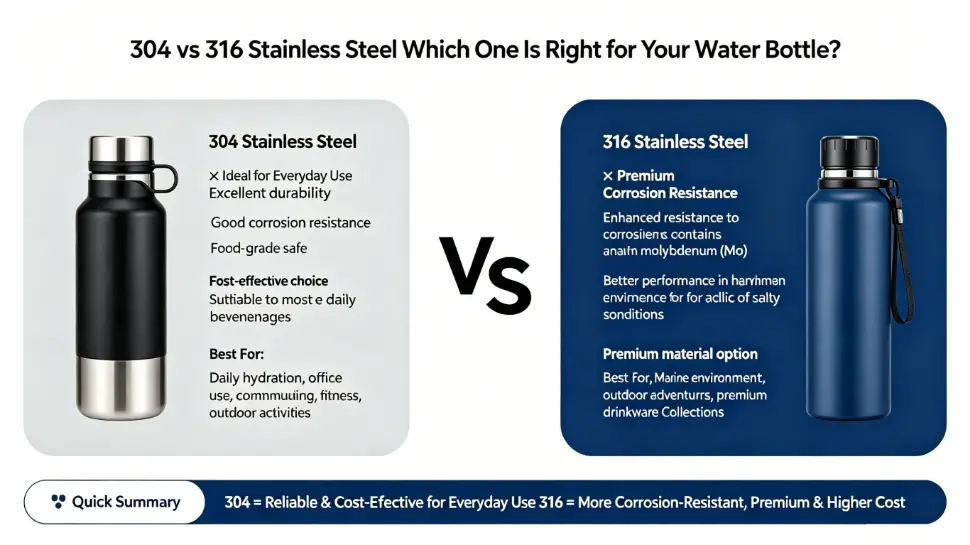
First, Let’s Talk About the Very Common One: 304 Stainless Steel
If you walk into a kitchen right now and start checking stainless steel items — cups, utensils, containers — there’s a good chance many of them are made from 304 stainless steel.
In the drinkware world, 304 is almost like the “default setting.” Many brands use it because it performs reliably and works well for everyday situations.
For example, it handles things like water, coffee, tea, or juice without any trouble. Its corrosion resistance is already strong enough for normal daily use.
Another reason 304 is so popular is balance. It offers solid performance while keeping production costs reasonable, which is why it has become a standard choice across the industry.
So for most people, a tumbler made from 304 stainless steel is already perfectly suitable.
Honestly, many of the well-known drinkware brands you see on the market today are using 304 as well.
Then Where Does 316 Stainless Steel Come In?
Now let’s look at 316 stainless steel, which often appears in higher-end product descriptions.
If we continue the earlier comparison, 316 is a bit like the “upgraded version.”
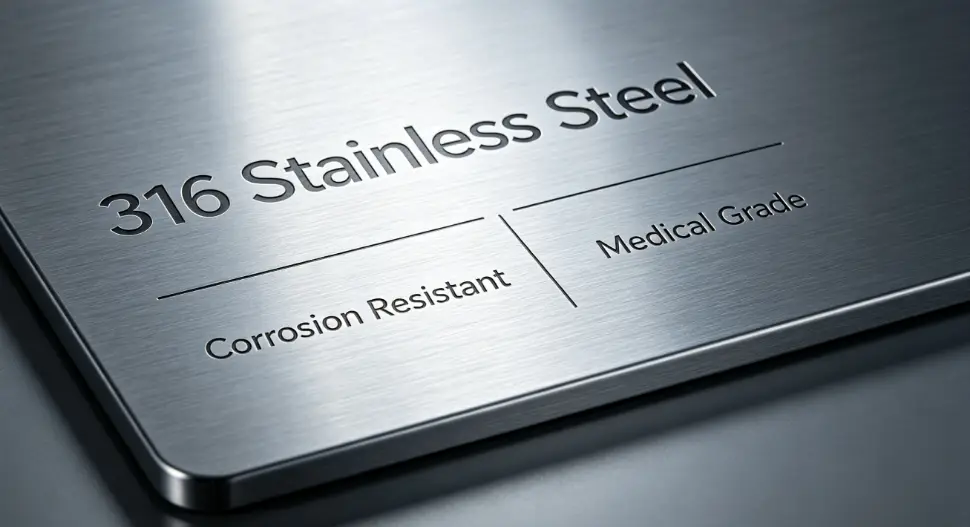
The main difference is that 316 stainless steel contains an additional element called molybdenum. This element improves corrosion resistance, especially in more demanding environments.
Because of that, 316 stainless steel is often used in industries such as medical equipment, marine applications, or chemical facilities.
That’s also why you sometimes see it described as “medical-grade stainless steel.” It definitely sounds impressive.
But here’s the interesting part.
Most people are not drinking coffee in a hospital laboratory or on a boat surrounded by seawater.
In normal daily life — commuting, working at a desk, sitting in a café — the conditions are actually very mild. And in those situations, 304 stainless steel already performs extremely well.
So while 316 does have stronger corrosion resistance, the practical difference during everyday use is often quite small.
So Which One Should You Actually Choose?
A simple way to think about it is this:
304 stainless steel is already very good.
316 stainless steel is simply more resistant to corrosion.
If you’re buying a tumbler for daily use — bringing it to work, carrying it in a backpack, or keeping it on your desk — 304 stainless steel will usually do the job perfectly well.
Of course, some people prefer 316 for premium products or for extra peace of mind. That’s completely understandable too.
But it’s important to know that the difference is not always as dramatic as marketing descriptions sometimes make it sound.
One Thing People Often Overlook
Interestingly, the material itself is only one part of the story.
When it comes to tumblers, several other factors can have an even bigger impact on the overall experience.
For example:
How well the vacuum insulation is made.
Whether the lid seals properly.
How durable the surface coating is.
And how consistent the manufacturing quality is.
A tumbler with thoughtful design and solid craftsmanship can perform extremely well even with standard materials.
In fact, a well-made 304 tumbler often ends up being more reliable than a poorly manufactured 316 one.
And that’s something many buyers eventually realize after using a few different products.
So, Does the Difference Between 304 and 316 Stainless Steel Feel a Bit Clearer Now?
A lot of people think materials or manufacturing topics are complicated and full of technical barriers. But very often, once you take a few minutes to look a little deeper, things start to make much more sense. What once felt confusing suddenly becomes pretty straightforward.
And in many ways, that’s exactly how we think about this industry.
The more people understand about materials, production, and product design, the easier it becomes to make confident decisions. Information shouldn’t feel hidden or difficult to access.
At Prliy, we always believe that transparency matters. When things are explained clearly, trust naturally follows. And in the long run, trust is built on understanding — not just marketing words on a product page.
So whether it’s 304 or 316 stainless steel, knowing the difference is already a good step toward choosing the tumbler that actually fits your needs.

Written by
Prliy
Prliy is a manufacturer focused on stainless steel drinkware, specializing in both core components and finished products. We are committed to creating bottles that perform reliably in everyday life — with a strong focus on insulation, food safety, and long-term durability.
Our products are developed and manufactured under strict, standardized, and sustainable processes, meeting multiple international food safety and environmental standards.
With years of industry experience, Prliy operates two stable production facilities in Zhejiang, China, along with an overseas warehouse in the United States. This integrated system — covering manufacturing, warehousing, and delivery — allows us to respond efficiently to customer needs while ensuring stable, long-term supply capabilities.
-
Share
-

-

-